• Subscribe to our Daily News Emails
  • Advertise
    • Media Info
    • Terms & Conditions for Advertisers
    • Mechanical Data

Broadband TV News

Independent. Since 2003

  • Home
  • News Line
    • Central & East Europe
    • People
  • TV
    • On Demand/VOD
    • IPTV
    • Cable
    • Satellite
    • Terrestrial
    • Distribution
  • Business
  • Tech
  • Events
    • Events Diary
    • BTN Events
    • Events Coverage
    • Submit the details of your event
  • Features
  • Resources
    • White Papers

Ericsson: AR and VR to merge with reality

June 22, 2017 07.18 Europe/London By Chris Dziadul

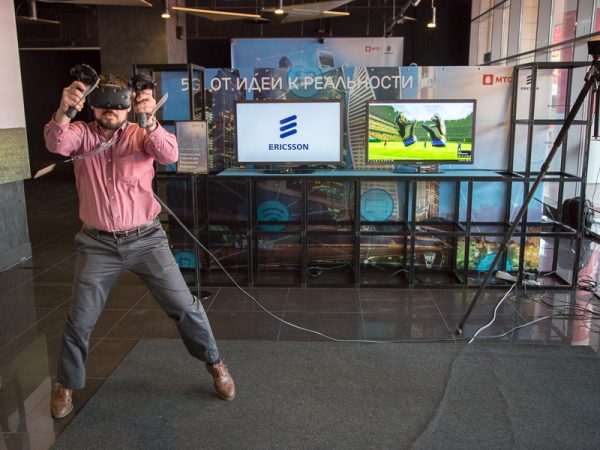
Seven out of 10 consumers believe that virtual reality (VR) and augmented reality (AR) will become mainstream in media, education, work, social interaction, tourism and retail, according to Ericsson’s latest ConsumerLab report.

It adds that media is already being transformed and consumers expect virtual screens to start replacing TVs and theatres in less than a year.

The report, entitled Merged Reality, reveals insights into how consumers expect VR and AR to merge with physical reality, and that 5G will be a key technology for such experiences to become mainstream.

It also says that when boundaries between people’s perception of physical and virtual reality start to blur, this could result in a drastic impact on lives and society. The way people live, work, and consume information and media will fundamentally change.

However, realities will not merge if the user is tethered to a computer or cut off from physical reality. Early adopters of VR/AR expect next-generation networks like 5G to play a central role. Thirty six percent have expectations on 5G to provide VR/AR mobility through a stable, fast and high-bandwidth network, while 30% of early adopters also expect 5G to enable tethered headsets to become wireless.

The qualitative research in the report included an innovative focus group discussion series completely in VR with participants from North America and Europe, as well as traditional focus groups with current users of VR from Japan and South Korea.

A series of qualitative VR tests with 20 Ericsson employees were also done to understand how lag in VR can trigger nausea.

In the quantitative part of the study, the report presents insights from a survey of 9,200 consumers in France, Germany, Italy, Japan, South Korea, Spain, the UK and the US, aged between 15-69. with awareness of the concept of VR.

  • Click to share on Facebook (Opens in new window) Facebook
  • Click to share on X (Opens in new window) X
  • Click to share on LinkedIn (Opens in new window) LinkedIn
  • Click to share on WhatsApp (Opens in new window) WhatsApp

Related

Filed Under: Newsline, Research Tagged With: AR, Ericsson, Virtual Reality, VR Edited: 22 June 2017 17:04

Avatar photo

About Chris Dziadul

Latest News

  • Hisense adds MagentaTV app to VIDAA smart TVs
  • Canal+ rolls out ‘Tango’ cinema brand campaign across Europe
  • Funke Digital launches three new FAST Channels on Samsung TV Plus
  • AMC joins Vectra line-up in Poland
  • New report urges rethink of in-car entertainment strategy

Most Popular

  • Warner Bros. Discovery launches HbbTV-based addressable ads on free-to-air channels
    Warner Bros. Discovery launches HbbTV-based addressable ads on free-to-air channels
  • Tina Rodriguez takes over Zattoo’s consumer business as Constanze Gilles leaves
    Tina Rodriguez takes over Zattoo’s consumer business as Constanze Gilles leaves
  • RT launches India channel during Putin visit to New Delhi
    RT launches India channel during Putin visit to New Delhi
  • Netflix–Warner Bros deal could cement Nordic streaming dominance
    Netflix–Warner Bros deal could cement Nordic streaming dominance
  • Italian competition authority fines Sky Italia €4.2m over ‘unfair’ price practices
    Italian competition authority fines Sky Italia €4.2m over ‘unfair’ price practices
  • Serbia Broadband to rebrand channel
    Serbia Broadband to rebrand channel
  • TiVo OS wins Freely certification for streaming devices
    TiVo OS wins Freely certification for streaming devices

White Paper

Virgin Media O2 turns to Starlink for UK-first ‘O2 Satellite’ service

Virgin Media O2 has struck a multi-year deal with Starlink’s Direct to Cell network to launch “O2 Satellite”, a handset-to-satellite service that will extend coverage into rural and coastal not-spots from early 2026. … [Download the White Paper ...]

Broadband TV News

  • Subscribe
  • About us
  • Contacts
  • Logos & Pictures
  • Privacy Policy
  • Terms and Conditions

Advertising

  • Media Info
  • Terms & Conditions
  • Mechanical Data
  • Video Services

News

  • Latest
  • Central & East Europe
  • TV
  • Tech
  • Streaming
  • Cable
  • Satellite
  • Terrestrial
  • IPTV
  • Business
  • People

Events

  • Events Diary
  • BTN Events
  • Submit the details of your event
  • Media Meet & Greet

Editorial

44 Telegraph Street
Cottenham, Cambridge CB24 3QF
news@broadbandtvnews.com

Commercial

Arundel View Cottage
Wepham
West Sussex
BN18 9RA
sales@broadbandtvnews.com

Connect with Us


Copyright © 2025 Broadband TV News LLP · Log in


Loading Comments...
 

    We use cookies to ensure that we give you the best experience on our website. If you continue to use this site we will assume that you are happy with it.